
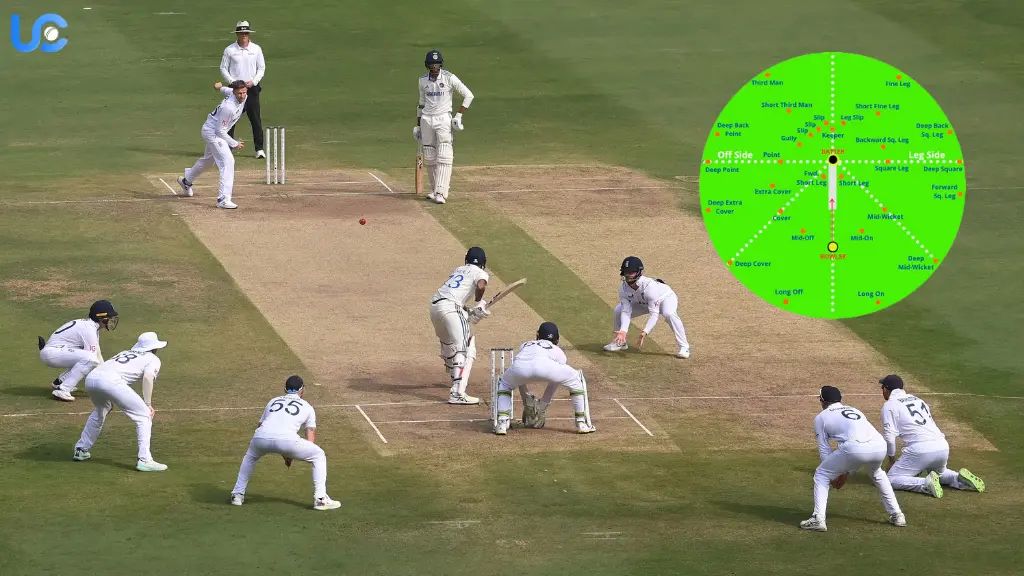
Cricket is a sport known not just for its intricate rules and formats, but also for its strategic depth. One of the most vital and often overlooked aspects of the game is field placement. Every fielding position has a purpose, shaped by tactics, conditions, and the playing style of both batsman and bowler. This article dives deep into cricket fielding position names, what they mean, where players stand, and why each role matters.
The Basics of Cricket Fielding Positions
Cricket is typically played on an oval-shaped ground with a 22-yard pitch in the center. Fielders are placed around the field depending on the type of bowler (fast or spin), the batsman’s strengths, and the game situation.
Fielding positions are usually classified into:
- Close-in fielders: Positioned near the batsman.
- Outfielders: Positioned near the boundary.
- Off-side positions: On the batsman’s bat-hand side.
- Leg-side (or on-side) positions: Opposite of the bat-hand side.
The batsman’s handedness (right or left) flips the off and leg sides.
Key Cricket Fielding Position Names and Descriptions
1. Wicket-Keeper
- Location: Directly behind the stumps at the striker’s end.
- Role: Catches balls the batsman misses, executes stumpings, and catches edges.
2. Slips
- Location: Next to the wicket-keeper, slightly behind the batsman.
- Types: First slip, second slip, third slip, etc.
- Use: For catching edges off fast bowlers, especially in seam/swing-friendly conditions.
3. Gully
- Location: Between slips and points, behind square on the off-side.
- Use: For catching edges that are not sharp enough for the slips.
4. Point
- Location: Square of the wicket on the off-side.
- Use: For cut shots and square drives. Can be deep or backward.
5. Cover
- Location: In front of the point, on the off-side.
- Use: For intercepting drives. Variants include extra cover and deep cover.
6. Mid-off
- Location: Straighter than cover but closer to the bowler on the off-side.
- Use: Stops straight drives and offers catching opportunities for mistimed lofted shots.
7. Mid-on
- Location: Mirror of mid-off but on the leg-side.
- Use: Stops on-drives and provides support for catches or misfields.
8. Midwicket
- Location: Square too deep on the leg-side.
- Use: To stop flicks and pull shots. Can be deep or short.
9. Square Leg
- Location: At a right angle to the batsman on the leg side.
- Use: For pull shots, sweeps, or nudges off the pads. Variants include deep square leg and backward square leg.
10. Fine Leg
- Location: Behind the batsman on the leg-side.
- Use: To collect deflections from glances or hooks. Can be deep or short.
11. Third Man
- Location: Behind the batsman on the off-side, close to the boundary.
- Use: Catches edged shots that beat the slips or glances that trickle away.
Advanced and Specialized Fielding Positions
12. Silly Point
- Location: Extremely close to the batsman on the off-side.
- Use: To catch defensive pushes or bat-pad deflections, typically against spinners.
13. Short Leg
- Location: Close-in on the leg-side, near the batsman’s pads.
- Use: To catch bat-pad deflections. Often wears a helmet.
14. Leg Slip
- Location: Behind square on the leg-side, similar to slip but on the opposite side.
- Use: To catch glances or edges off the pad.
15. Fly Slip
- Location: Deeper than traditional slips.
- Use: For catching upper edges or late cuts.
16. Long Off / Long On
- Location: Near the boundary straight down the ground on off-side (long off) or leg-side (long on).
- Use: For catching lofted shots.
17. Deep Cover / Deep Extra Cover
- Location: On the boundary on the off-side.
- Use: To stop or catch big drives.
18. Cow Corner
- Location: Between deep midwicket and long on.
- Use: For catching slogged or mistimed leg-side shots. Term is informal.
19. Deep Fine Leg / Deep Square Leg
- Location: On the leg-side boundary.
- Use: For short balls or glances.
Unusual and Fun Terms in Cricket Fielding
Cow Corner
This is an informal term for a region between deep midwicket and long on. It originates from village cricket where cows often grazed in that area of the field, and shots played there were considered unsophisticated “cow shots.”
Sweeper
A fielder placed on the boundary in a wide arc, often on the off-side, used in limited-overs cricket to prevent boundaries.
Helmet Fielders
In modern cricket, particularly in Test matches, you’ll see fielders wearing helmets at short leg, silly point, or leg slip due to the danger of close proximity.
Field Placement by Bowling Style
Fast Bowlers
- More emphasis on slips, gully, point, mid-off, and third man.
- Fields are usually more spread to protect boundaries in limited-overs formats.
Spin Bowlers
- More close-in fielders: short leg, silly point, leg slip.
- Spinners entice the batsman to make a mistake, and these positions catch deflections.
Fielding Restrictions and Modern Rules
In limited-overs cricket (ODIs and T20s), there are fielding restrictions:
- Powerplay Overs: Limited number of fielders outside the 30-yard circle.
- Inner Circle: Enforced to prevent overly defensive fields.
- Only 5 fielders on the leg side are allowed at any time (to prevent negative bowling tactics).
The Importance of Fielding Positions
Each fielder is like a chess piece — strategically placed to exploit a weakness or protect a strength. Misplacing one can result in leaking runs or missed chances. Captains use field placements to:
- Attack (e.g., close-in catchers for new batsmen).
- Defend (spread out to prevent boundaries).
- Balance pressure (rotate between attacking and defensive positions based on match context).