
The cricket pitch is undeniably the most significant part of the game. This is where the very main event of a cricket match takes place! Such a great deal, yet the size of the pitch that the cricketers play on is usually one of the game’s least known facts.
The field can have all different kinds of shapes since there aren’t any set rules for field size. The outfield and pitch, however, should be rectangular and the infield should have a curving border. The pitch has a definite length while the ground does not; we will discuss all the dimensions and features of the cricket pitch below.
The overall dimensions of a turf wicket even according to the cricket match standard will be different. The rectangular zone at either end of the cricket pitch, which is the bowler’s area, the stumps and creases are located, determines the size of the pitch. Hence, the “pitch” is the primary location where a cricket match’s action occurs.
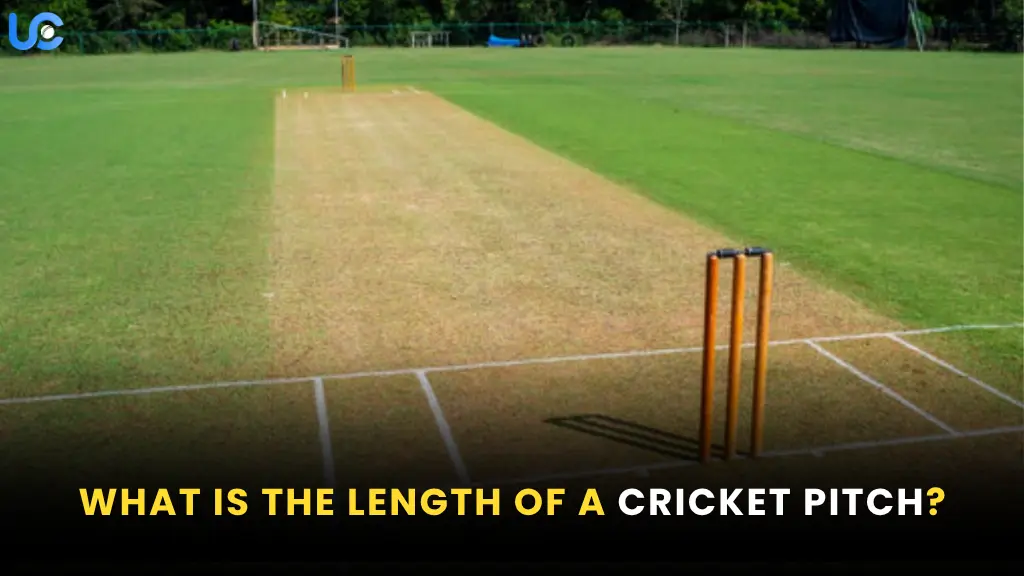
What is the length of a cricket pitch?
The MCC law states that the cricket pitch is to be 10 feet (3.05 meters) wide and 22 yards (20.12 meters) long. The ball might bounce on the flat surface as it is bowled to the batsman. Wicket and batsman’s ground at each end of the field. The bowler has to throw the ball to one of the batsmen or the wicket at the far end of the pitch; otherwise, the throw is a no-ball.
The cricket crease needs to measure 8 feet 8 inches (2.64 meters) long. The popping crease, or the back edge of the crease marking, must be 4 feet/1.22 (1.22 meters) away from the bowling crease and parallel to it.
The bowling crease is 1.22m from the edge of the pitch, and it is marked at least 1.83m on either side of the two centre stumps.
Cricket Pitch Measurement and Dimensions
There must be a minimum of 1.22 metres behind the stumps to allow for the return crease and bowler’s approach area. The distance between the stumps on the cricket pitch is 20.12 metres. A grass pitch measures 3.05 meters in width.
The overall dimensions of a turf wicket even according to the cricket match standard will be different. The rectangular zone at either end of the cricket pitch, which is the bowler’s area, the stumps and creases are located, determines the size of the pitch. Hence, the “pitch” is the primary location where a cricket match’s action occurs.
Which are the terms associated with the cricket pitch that the cricketing world uses?
The term “square” lists one specific location on the pitch. Here, the previous matches were played just adjacent to the pitch. You can place a pitch anywhere on the square, and it will just stay there till it is called for use.
The outfield area is actually beyond the square and goes up to the boundaries. Although “square” and “outfield” are regularly used terms, they do not carry any significance in the game rules. The surface is faster at the square because the grass is shorter and the ball has already been used in the game.