
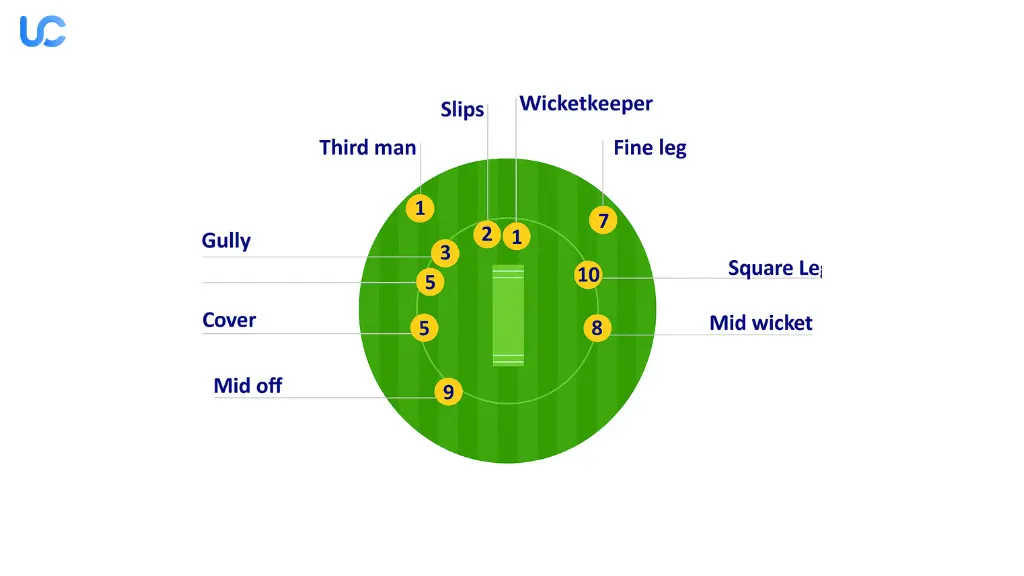
In the thrilling and rapid game of cricket, fielding is a decisive element that can sway the outcome of a match. Mid on and mid off are two of the most difficult positions to field and are also among the most significant ones in the game. These positions are indeed very important for any team, as they require a perfect combination of skill, intuition, and precision.
By placing mid on and mid off at the center of the fielding arrangement, the two players create a defensive barrier by standing on both sides of the 30-yard circle, just inside the pitch.
Their core responsibility is to block the batters from reaching the boundaries and gaining runs by cutting off their straight drives and grounded strokes.
Mid On and Mid Off
Mid on is positioned on the leg side of the pitch, directly next to the umpire. The fielder playing this position must be very quick and have good reflexes as the ball can be powerfully and lowly hit towards the leg side.
To ensure the ball does not go beyond the boundary, the mid on fielder needs to predict the shot’s direction, make a swift move, and jump.
Read Also:- What Is a Mid Wicket in Cricket?
Mid off is just the opposite of mid on and is positioned on the left side of the umpire, on the off side of the pitch.
He is doing the same thing as mid-on, but since he often has to take lofted shots over the field, he must also judge the ball’s height. The position of mid off calls for speed, intuition, and a strong understanding of the catch.
Fielding Strategies
The captain adeptly shifts the positions of mid on and mid off to suit the batsman’s nature and the game situation.
If the batter is attacking through straight hitting, mid on and mid off will be brought closer to the bowler and tighter defensive ring will be formed. Conversely, the outfielders will move back for offering better boundary coverage if the batsman is playing cuts and pulls more often.
Mid on and mid off do more than just hold the runs back. They are vital in applying pressure on the batsman, making him hesitant before playing and taking risks.
A quick and well-placed mid on or mid off can even get the wicket by stopping hard shots.
Long On and Long Off
While long on and long off provide extra coverage in the outer ring, mid on and mid off form the defensive core in the inner ring.
The main responsibility of these players is to stop the batsmen from hitting over the field, so that the ball can’t reach the boundary or even bounce once for six runs. They are stationed close to the boundary, one on the leg side and the other on the off side.
At leg side boundary, long on expands the defensive area beyond mid on’s reach. They must have a strong throwing arm and be quick to get to the ball in order to prevent batters from taking extra runs.
The long off, which is a long counterpart to the long on, takes up the off side boundary and provides yet another protection against high shots. In order to prevent boundaries or sixes, they need to have the best judgment of the flight of the ball, be able to foresee the shot’s path, and do quick receptions.
Finally, along with long on and long off, mid on and mid off create a full defensive unit. The captain is the one who decides their positions and moves to create a living defensive wall that varies according to the match and the batter’s style.
Conclusion
Among all the fuss over batting and bowling, the players at mid on, mid off, long on, and long off are usually the least noticed. However, their contributions can never be underestimated considering the final results of the match.
They are the unnoticed champions of cricket since their dexterity, foresight, and accuracy are the main factors of a team’s defensive deployment. Thus, their role in the match becomes significant.