

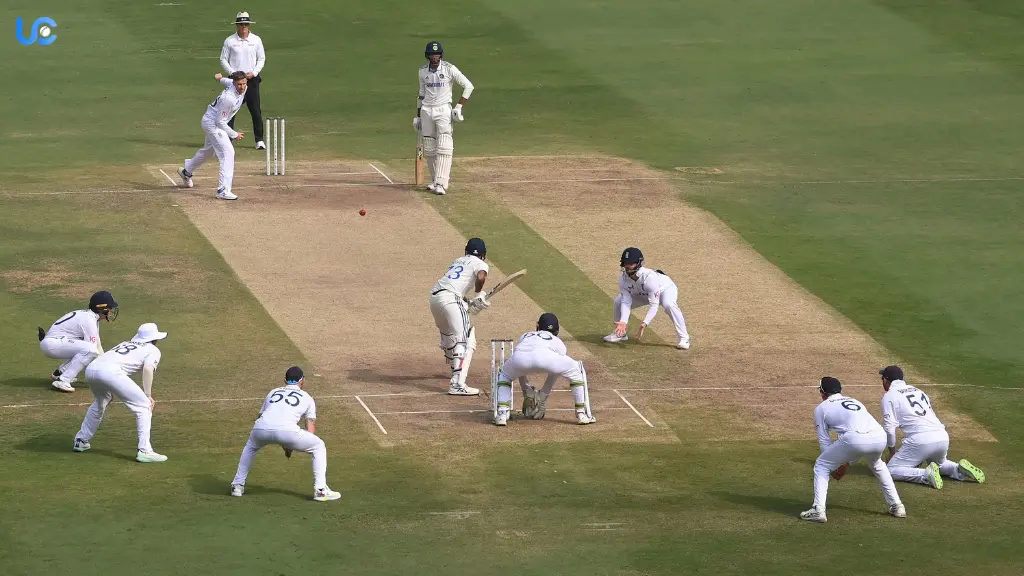
If you are an enthusiastic fan of cricket, you certainly must have observed that cricket teams are allowed to place only two fielders behind the square on the leg side. But what is the basis for this field restriction?
In order to answer this question, let us travel back to a century before when this rule wasn’t even existing. So, through this article, we will unfold the square-leg fielding restrictions in cricket.
Why are only 2 fielders allowed behind square leg? Know the reason
The thing is, in the beginning, when cricket was played, there were no such field restrictions. However, a certain event took place in the 1932-33 Ashes Series, prompting the Marylebone Cricket Club (MCC) to become aware of it.
England was on an Australia tour to continue the Ashes series with the country’s greatest batsman, Don Bradman. The Australian batsman was in the best of his form before the series, and the English bowlers were trying to figure out a way to negate him.
Read Also:- West Indies Players Central Contracts, Match Fees, Salaries, etc
England, in order to prevent Bradman from getting the runs, decided to use a bowling tactic which was referred to as ‘bodyline’. This was not a usual bowling strategy but was, in fact, quite controversial one that received a lot of criticism and at the same time the relations between the two teams were strained as well.
The bodyline tactic was so controversial that it caused the diplomatic relations between Australia and England even to be set back. So, what was the bodyline tactic?
In those times, no rules existed for fielding on the leg side. Therefore, Douglas Jardine, the captain of England, had the bowlers he wanted to bowl short-pitched deliveries at the body of the batsman and surrounded the area with catchers very close on the leg side.
This strategy was intended to hinder the batters from scoring falls by guiding them to hit the leg side only. The plan was specially designed for Bradman since he was not in his zone while playing short-pitched balls.
In the process, Bradman and other Australian batters were mercilessly attacked by England’s fast bowlers and got into a lot of trouble because of the many hits they took to their bodies.
England used this method to win the 1932-33 Ashes Series by 4-1, and more than several people frowned upon it as the bodyline strategy being wrong and against the rules of the game.
The Consequences of the Bodyline Strategy
During the summer of 1933, the West Indies cricket team toured England and the English players saw bodyline in action. Following the series, the Marylebone Cricket Club (MCC), the custodian of the laws of the game of cricket, imposed regulations to prevent the bowlers from adopting the method.
The game’s governing body proclaimed that any bowler directly attacking the body of the batsman was unfair, and the umpires were instructed to intervene. In 1957, the MCC went even further by making a ruling to enfeeble the fielding side from placing more than 2 fielders backward of the square leg.
The primary goal behind it was to deter off-spinners and slow bowlers from bowling leg-stump-line deliveries with a close set of fielders on the leg side. But, at the same time, the opposition was also not allowed to adopt the bodyline tactic anymore due to the rule.
Furthermore, the MCC introduced the restrictions of the numbers of short-pitched deliveries that a bowler can bowl in an over.
In the end, due to all these happenings, the team was limited to 2 fielders behind the square leg only.