
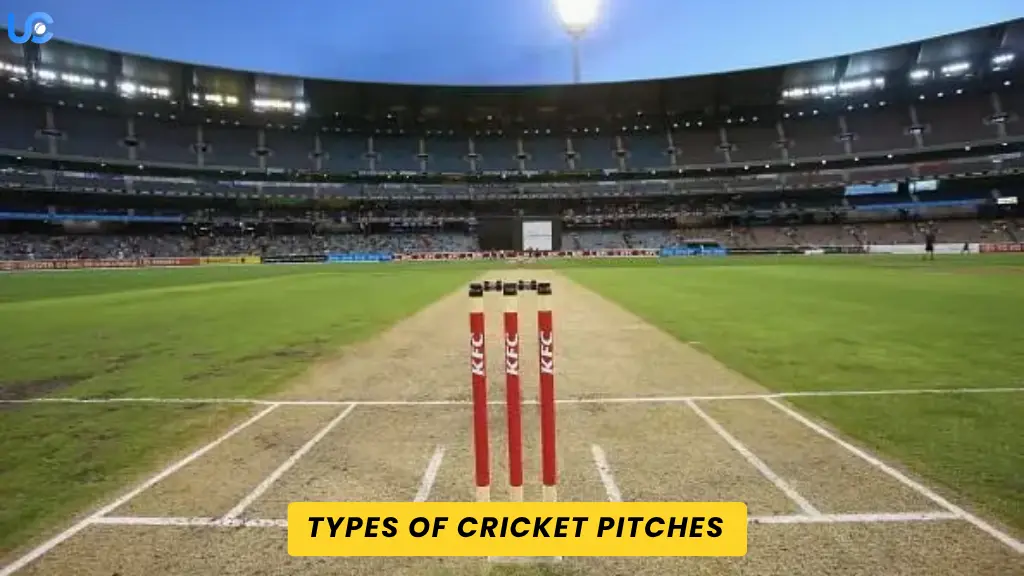
In case you are a cricket fan for quite some time, the pitch report is something that you have surely seen the commentators presenting right before the match. This is where they explain the pitch type meant for that specific game.
Cricket showcases six different pitches that exhibit diverse characteristics. Let us now discuss the different types of cricket pitches in this article.
Types of Cricket Pitches
Flat Pitch
The advent of T20 cricket has led to the emergence of flat pitches. These are now used in T20 matches more often as they benefit the batters. Probably by now you have a little picture in your mind regarding what a flat pitch is.
Read Also :- Best Cricket Stadiums In South Africa
The flat surfaces do not offer much resistance to the. Fast bowlers are not happy with such surfaces, while they are the most. Batters get to score huge runs on such courts.
Green Pitch
As the name suggests, these pitches are green because of the grass cover on top of the surface. Such pitches are prepared in England or New Zealand for Test matches.
The green pitches help fast bowlers greatly with the new ball which can possibly give the batters hard times. And such pitches can bring about bat and ball fight as the ball gets older, allowing batsmen to score thereby increasing their runs.
Wet Pitch
In most cases, wet pitches are not prepared intentionally, but they can be found in a few exceptions. If the surface has been covered for a longer period due to rain, then the pitch may become wet or sticky.
Such pitches are not very friendly for batsmen as the ball will not bounce the same way all the time because it is sticking to the surface.
Dry Pitch
A dry pitch is the absolute opposite of a wet pitch. The pitch is moisture-less and perhaps cracks will start to form during the match itself.
Batters, on the other hand, will not encounter any problems during their stay at the crease if they are provided with such surfaces. Nevertheless, in case a bowler manages to hit one of the cracks of the pitch, the ball might change its path and surprise the batters.
Dusty Pitches
Dusty pitches will become the common sight in the subcontinent countries. Such places are not heavily rolled and thus they do not get completely covered with dust.
The dusty pitches turn spinners into miracle makers with their enormous but unanticipated spins, which may take the form of batters being out. Fast bowlers get little to nothing and thus their position in dusty pitches is really bad.
Dead Pitch
A dead pitch can be compared to a flat pitch, which gives nothing much to the bowlers but can still deliver high-scoring matches as no grass or moisture exists on the surface.
Nevertheless, a dead pitch may challenge the batters as the surface goes through aging causing cracks to emerge. One is likely to experience the pitch’s inconsistent bounce where getting hit by the ball or losing one’s wicket are the two most probable outcomes for the batters.