
People just starting with cricket may find the terms ‘leg side’ and ‘off side’ quite difficult to comprehend. Nevertheless, if you are interested in cricket, you must know these terms. They are just about the most important aspects of a cricket field.
During a cricket match, if you see it a few times, you will listen to both terms voiced. Moreover, if you are a cricket player, the terms off-side and leg-side will surround you during your practice.
Before being able to grasp the essential meanings of these two terms, one has to know them first.
Off Side and Leg Side in Cricket
A cricket ground shows us that it is made up of two sides: the off side and the leg side. A batsman or the player can hit the ball coming to both ends to gain more runs.
On the off side, the batsman will be able to play strokes such as off drive, cover drive, and cut shots. Pull, Hook, Leg glance, and so on are examples of the shots that a batter can play from the leg side.
In cricket, on side and off side mean each of the two halves of the wicket. The positioning of the batters determines them.
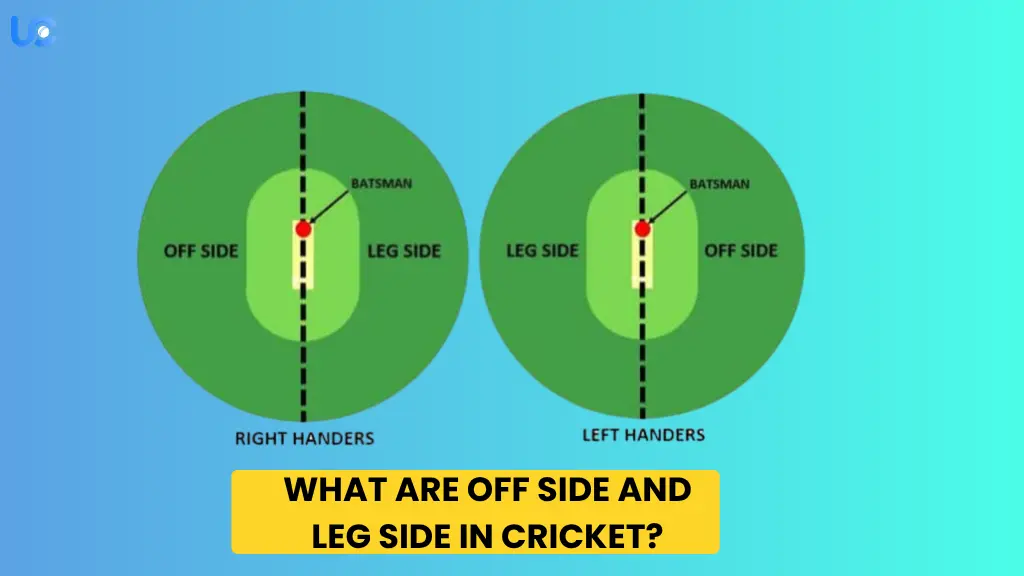
For a right-hander, the leg side is the entire cricket field to the left when he is looking at the bowler. The off side is everything on his right.
For left-handers, the scenario is reversed. The left-handed batter’s leg side is to the right while the off side is to the left.
From the viewpoint of the audience in the stands, the off side and leg side are very much a matter of perspective. They are not fixed positions; they change according to the batter’s position.
Read Also :- What Are Byes and Leg Byes In Cricket? Here’s What You Need To Know
Significance of Off and On Sides in Cricket
For cricket enthusiasts, these phases will be helpful in understanding the various facets of the game like the different types of fielding situations and batting techniques.
Some must-know words are:
Long off and long on
Mid off
Leg gully
Knowing the location of these two features in a field enables one to scrutinize their positions, and from that, the players may infer the fielders’ general placing.
Fielding Position Laws
There are many laws and regulations that specify the fielders’ placements during a cricket match. A couple of these restrictions are particularly around the number of players or fielders that each captain is allowed to place on the batter’s side.
With regard to the leg side, the rule states that not more than two fielders may be at the back of the square, and this law is applicable in all forms of cricket. If the ball is hit and the law is broken, the umpire has to declare it a “no ball.”
Wrap Up
Initially, when you start watching or playing cricket, these terms might be a bit of a puzzle, but once you realize that they are all pointing out to the batsman, they should be easier to understand.
Fielding positions, shot selection, and even commentary heavily rely on these terms, hence you must make an early effort to learn what they mean very well.