
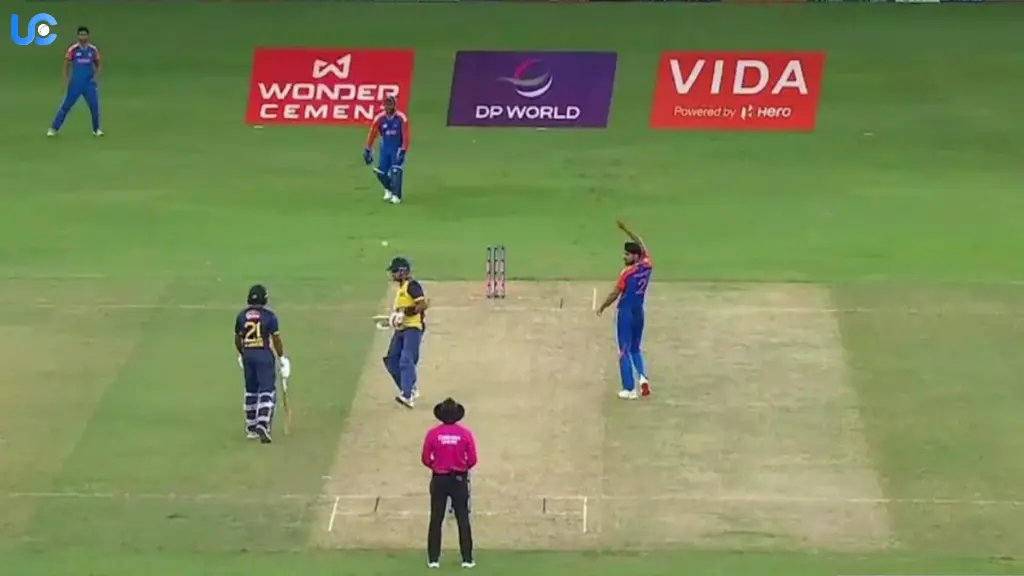
A controversy erupted during the 2025 Asia Cup match between India and Sri Lanka. Dasun Shanaka was given not out even though he was outside the crease when Sanju Samson hit the stumps off Arshdeep Singh’s delivery in the Super Over at the Dubai International Stadium.
It was clear that Shanka was out but the third umpire gave him not out. The Indian players were surprised and asked the umpire and he explained his decision. Although Shanka was out in the next ball the call didn’t change the game.
Why was Dasun Shanaka given not out?
Shanka was far away from the crease and Arshdeep had appealed for a caught behind which hurt India. The on field umpire raised his finger right after Samson hit the stumps. Shanka asked for a review.
Read Also:- Zimbabwe Drop Sean Williams Ahead of T20 World Cup Africa Qualifier
The replays showed that Shanka didn’t edge the ball so the decision was reversed. Many thought this meant Shanka would be given out for being run out. But Shanka was allowed to continue batting.
Why was Shanka not out? Because the ball was dead before the run out. According to rule 20.1.1.13 of the MCC Laws a ball is dead from the time an incident causes it to be dead. So even though the umpire raised his finger after the run out the ball was already dead when it reached Samson’s gloves.
Similarly if an umpire gives a player out but that player takes a single or double or hits a boundary and then asks for a review those runs won’t count if the decision is overturned.
What are the Rules?
Here’s rule 20.1 (Ball is Dead) from the MCC Laws:
20.1 Ball is dead
20.1.1 The ball becomes dead when
20.1.1.1 it settles in the wicket-keeper or bowler’s hands.
20.1.1.2 a boundary is scored. See Law 19.7 (Runs scored from boundaries).
20.1.1.3 a batter is out. The ball is dead from when the incident that caused the dismissal occurred.
20.1.1.4 it gets stuck between the bat and the batter or their clothing or equipment, whether they played the ball or not.20.1.1.5 it gets lodged in a batter’s clothing or equipment, or an umpire’s clothing, whether they played the ball or not.
20.1.1.6 there is an offence under Laws 24.4 (Player returning without permission) or 28.2 (Fielding the ball) that leads to penalty runs. The ball won’t count as one of the over.
20.1.1.7 there is a breach of Law 28.3 (Protective helmets belonging to the fielding side).
20.1.1.8 the match ends.