
It is very common to see a batter getting out without scoring anything and then the commentators say that the player is out for a duck.
But what does a duck mean in the case of cricket? How did the term become a part of the game? What are the different types of ducks?
This article aims to explain the meaning and different types of ducks in cricket.
Duck: A Bird or A Cricket Term?
The word chosen may be confusing, but the bird and the term used in cricket are already different and non-overlapping; and this is how the term ‘duck’ in cricket was created.
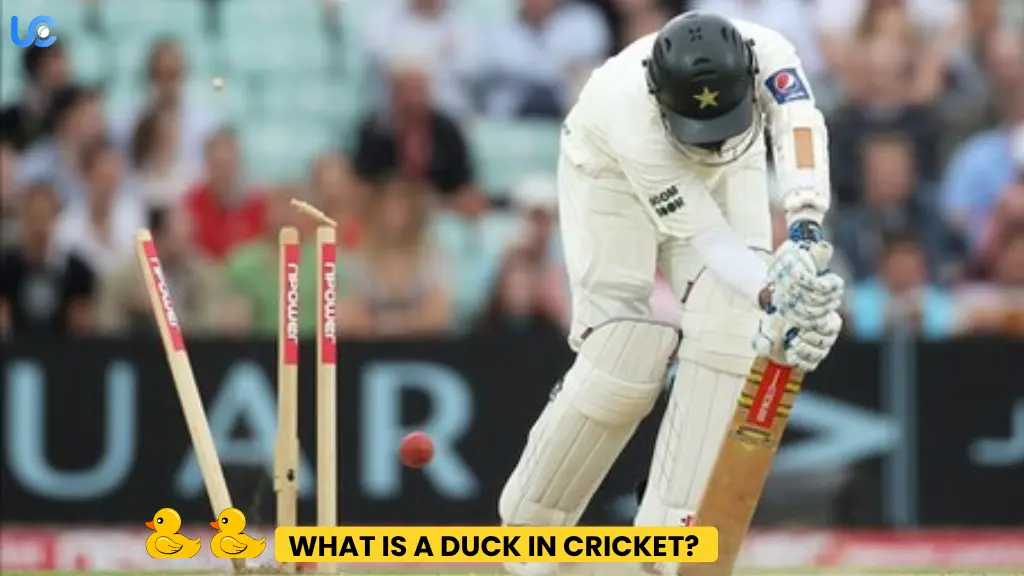
In cricket, a duck simply stands for a batter who got out without making a single run scoring – out on zero. And it is unfortunate whenever a batter is out for a duck.
And how did the term come up?
No one can say for sure who invented it, but the term is quite close to bird ‘Duck’.
Read Also :- Highest Partnership By Number 11 In T20I
In olden times, when the scorers used to keep the scorebooks, they thought that ‘Zero’ (0) resembled a duck’s egg. At that time, if a batter was out for nil, instead of saying ‘out for zero’ they said it was and as it was the case of ‘duck’, it was then shortened to just ‘duck’.
Now, let us discuss the various kinds of ducks that exist in the game of Cricket.
Types of Ducks
Although the word ‘duck’ is used to refer to a very general situation, there are some different types depending on when exactly a player is dismissed.
1. Golden Duck
The term golden duck is used when a batsman is caught out on his very first ball. This is a case of the most controversial dismissal, for no player around the globe wishes to be out at the very start of the game.
2. Silver Duck
If a batter is out on the second delivery they played and no score is recorded, it is called a silver duck. This term, in contrast to the golden duck, is not very often used, and such a dismissal may be referred to as a simple duck.
3. Bronze Duck
The bronze duck follows the golden duck and silver duck. It indicates a player got out on the third ball they faced without scoring a run.
4. Diamond Duck
The term may sound attractive, but wait, it’s another unfortunate way to get out in cricket. The diamond duck happens when a batsman is out even before facing their opening delivery in the innings. This will only happen if a batter is run out, obstructs the field, or is timed out.
5. Royal Duck
This type of dismissal, contrary to its name, would not make the batter feel royal at all. When the first batter of the side gets out on the very first ball of their team’s innings, it is called a royal duck.
6. Laughing Duck
After seeing this term, did you start laughing? Good if you had a little laugh
Now back to the term, the laughing duck occurs when a player is out on the last ball of his/her team’s innings without scoring a run.
7. A Pair
This type of duck mainly happens in the longest format of the game – Test or First-Class Cricket. If a player is out on a duck in both innings of a match, then it is termed ‘a pair’..
8. King Pair
A king pair is when a batsman is out for a golden duck in both innings of a match. And don’t mix up ‘pair’ with ‘king pair’, as only a ‘king pair’ can occur through the batsman being out on the very first balls of both innings.
9. Batting Hattrick
It’s slightly the same as the bowling hat-trick, but it covers three consecutive innings in Test cricket or First-Class cricket. The batsman must be out three times with three consecutive balls, and it will then be recorded as a batting hat-trick.