
Cricket is a sport that can never be predicted, since every ball has the potential to bring about some kind of climax. One minute everything seems to be going on smoothly and the next moment a player might get out or someone can hit a huge six which might turn the game upside down.
Such things happen more often in limited-overs cricket, where every single moment is of utmost importance. Nevertheless, Test cricket also has its share of spectacular moments that twist the game.
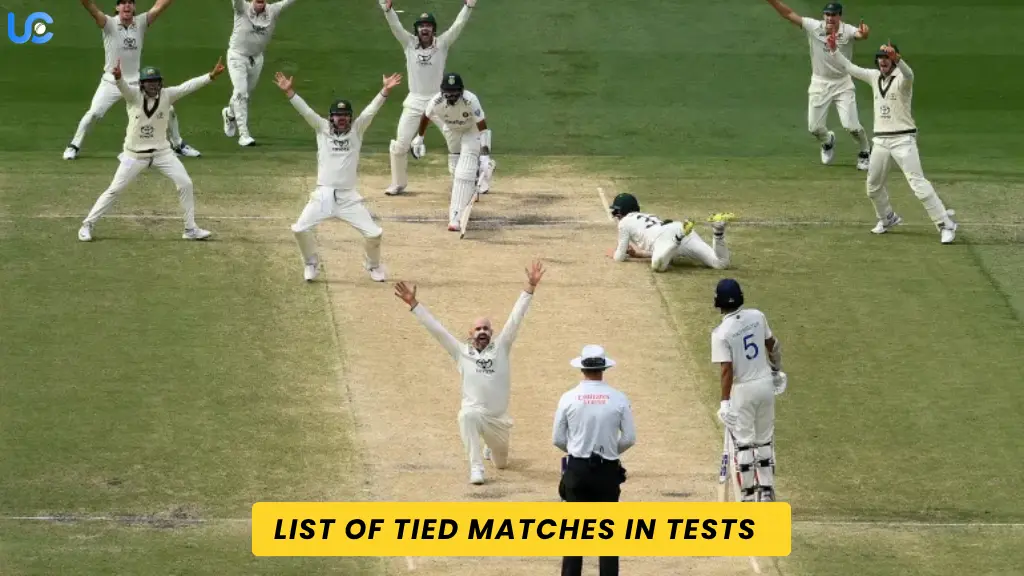
The most exciting part about tied matches in cricket is that they create a lot of suspense and keep the viewers and the players alike on their toes. Limited-overs cricket sometimes ends in a tie but such instances are quite rare in Test cricket and only two have been recorded so far.
This article will focus on the tied Test matches that have occurred in cricket history. (Before we start, let’s be clear on the rules concerning tied Test matches in this regard.)
1. Australia vs West Indies – Brisbane, 1960
The very first tied Test match occurred in December 1960. The West Indies were in Australia for a 5-match Test series, and the epic tie gradually developed from the very first match.
Selecting to bat first, the Windies amassed 453 runs, courtesy of a magnificent 132 by Garry Sobers. The host’s Alan Davidson was the star with the ball as he claimed 5 wickets in the first innings.
Read Also :- Test playing nations in international cricket
Next, the Australians took their turn with the bat, the openers providing a solid start. However it was Norm O’Neill who scored 181 which helped the hosts to be ahead by the slightest yet most important margin of 53 runs when the Windies had finished their bowling giving them a total of 505.
In their 2nd innings, the Windies had no trouble scoring 284 runs and, thus, set a target of 233 runs before the Aussies. Davidson, bowling brilliantly, took 5 wickets again conceding 87 runs and making the tally of wickets taken by him to 6 for 87 runs.
The hosts aimed at the target and got 2 quick wickets in no time and were in a difficult position at 92/6. However, the best bowler Alan Davidson (80) along with captain Richie Benaud (52) played a good partnership.
Their resistance brought Australia to the point of winning the match, but a greater twist was waiting to be seen in the match. The hosts lost Davidson at 226, and the equation turned to 7 runs to win with 3 wickets remaining.
The match entered the last over with 6 runs still needed to win the game. Benaud, however, returned to the dressing room caught out, and Wally Grout was run out.
Australia was then at 232/9 and scores were level; they just needed 1 run off 2 balls. The last pair, Ian Meckiff and Lindsay Kline, attempted to sneak a run but Joe Solomon shattered the stumps with a blazing throw and the match ended in a tie.
2. India vs Australia – Chennai, 1986
Australia, after a gap of 16 years since the first-ever tied Test, found themselves witnessing another enthralling tie encounter, this time with India. Incidentally, the thrilling contest also took place in the very first match of the 3-match series.
Australia made the decision of batting first and the batters justified it. Dean Jones hit a remarkable 210 runs, besides the two centuries David Boon (122) and Allan Border (106) contributed. The batting onslaught put the visitors in control, and the declaration of the innings was made on 574/7.
The Indian bowlers put up a fight against the Australian bowling attack but got all out for 397 runs eventually. It was the captain Kapil Dev’s fighting 119 runs who kept India from either ceding a large lead or being asked to follow on.
After the lead of 177 runs, Australia declared the innings and set a target of 348 runs after adding 170 runs more. On the last day, India had the daunting task of chasing the target in 87 overs.
Sunil Gavaskar, who had difficulty in the first innings, played a pivotal role in India’s favor by scoring 90 runs. Other batsmen also contributed greatly, but the spinners of Australia, Greg Mattews and Ray Bright, complicated the situation for the hosts.
India seemed to be in a strong position at 331/6 but then Bright took 3 wickets in the next 13 runs which left India struggling on 344 with only 1 wicket left. Now, India was asking for 4 runs in the last over before the winning total was declared.
Ravi Shastri was at one end with the last batsman, Maninder Singh, at the other. They managed to take 3 runs in 4 balls which left 1 run needed off 2 balls for the victory.
With the scores level, the pressure was on Maninder Singh to take India over the ropes. But, Matthews trapped Singh LBW, thus giving us only the second tied Test match in history.