

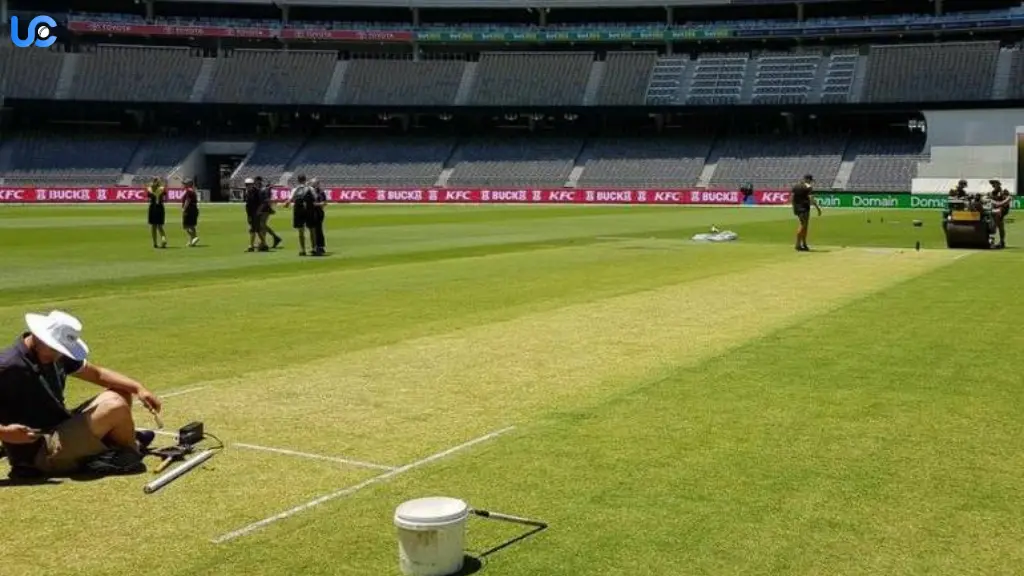
For over four centuries, cricket has been a sport that people have been enjoying. Throughout these years, the game of gentlemen has changed in a multitude of ways.
Among the many impressive changes that cricket has gone through, the hardest to believe is the use of drop-in pitches. The Nassau County International Cricket Stadium, located in New York, has been prepared for the 2024 T20 World Cup with the help of drop-in pitches.
However, what exactly are these drop-in pitches? What is the process for making them? And what is the purpose of using them?
Never fear, we will provide the answers.
Our article will serve as a complete guide on drop-in pitches that are used in cricket.
What is a Drop in Cricket pitch?
The drop-in pitches are almost identical to that of the traditional pitches. The only distinction is that the drop-in pitches are prepared at another place, then transported to the site and planted at their pre-decided positions.
This method is a common practice for Australia and New Zealand. Many famous Australian cricket venues like the Melbourne Cricket Ground (MCG), Adelaide Oval, and Perth’s Optus Stadium are making use of drop-in pitches. Moreover, in New Zealand, Auckland’s Eden Park and Wellington’s Westpac Stadium are also instituting these portable pitches.
But why are drop-in pitches used?
The thing is that the stadiums in Australia and New Zealand are heavily utilized for multiple events—be it other sports like football, rugby, etc., or functions such as music concerts.
Besides, cricket is played during summers in Australia and New Zealand. So the same stadium has to be available for other events in the same season as the cricketing activities, once the conclusions are drawn.
Consequently, the plan to utilize drop-in pitches was introduced. Prior to the start of the cricket season in these nations, the ground authorities using cranes place the pitches in a pit with a cement base at the center of the ground.
The pitches are taken out after the cricket season, the empty pit is filled with sand and then the artificial turf is rolled over this.
Observe the process of drop-in pitches installation:
When was the first use of this method?
It all started in 1977 when the World Series Cricket, founded by Kerry Packer, had to play their matches in football stadiums. The Australian cricket authorities did not allow the cricket competition to use cricket venues and thus, the idea of drop-in pitches was conceived.
Packer asked pitch curator John Maley to develop the drop-in pitches, which later on were installed in some football venues.
How are drop-in pitches made?
Indoor greenhouses are used for making the pitches, which provide the proper climate control. The making of drop-in pitches is done by mixing native soil, clay, and couch grass, which is the top cover.
This soil is all packed into steel trays measuring about 24 meters long, 3 meters wide, and 200 millimeters deep. The pitches are then taken from the tray and transported to the site for installation.
What is the nature of drop-in pitches?
Drop-in pitches predominantly support batsmen since they do not change with the match and thus do not crack. They are hard because the grass is firmly rooting the soil, as the tray method was used for preparation.