
Rain interrupting cricket matches is quite a common and frequent incident for many years. Meanwhile, it has been accepted that cricket is among the very few sports that usually get halted when a heavy downpour occurs.
Rainfall pauses the ongoing match, and the long wait for the outfield to dry starts. This is quite annoying not only for the players but also for the spectators.
However, the situation is different in some cricket stadiums, as a certain system is in place that drains the water much quicker.
What is this system, one may ask?
It is called the SubAir Drainage System.
Let us explore the SubAir Drainage System and its operation in this article.
Sub Air Drainage System, after all?
It is an ultra-modern drainage system, and its main purpose is to clear the outfield of water. The subsurface aeration and vacuum-powered drainage system has been developed by the US-based SubAir company.
Read Also:- What Is the Cost of LED Stumps in Cricket?
The SubAir system clears the water in no time and hence the match can be resumed with very little delay. This not only minimizes the possibility of the match getting canceled but also prevents the game from being held up due to a wet outfield.
Besides cricket, the SubAir system can be found in different venues such as golf courses, football, baseball, and rugby stadiums all over the world.
What is the functioning of the Sub Air Drainage System?
The SubAir method involves the use of a pipe network installed under the surface of the outfield that has holes for both aeration and drainage. Consequently, a closed-loop system of perforated pipes along with remote sensors gets installed beneath the outfield.
Furthermore, this setup gets hooked up to the SubAir Sport System, which starts operating when the rain falls over the ground.
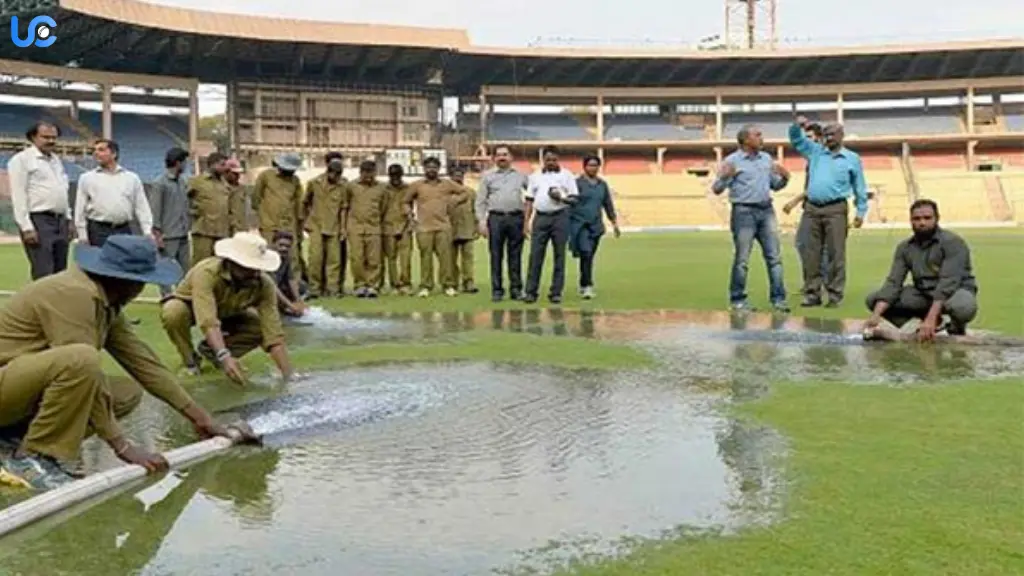
Rain detection through remote sensors triggers the system to swing into action sucking out water at a rate 36 times more than what natural drainage might take. The perforated pipe system under the outfield drains off water at an incredible speed of 10,000 liters per minute.
Thus, the outfield gets cleared without water puddles forming on the surface.
What are the benefits of the Sub Air Drainage System?
Among its many benefits, the SubAir System ranks first in helping to resume games in less time, thus reducing delays and cancellations.
Moreover, the system assists ground curators in keeping a turf surface that is healthier and safer.
The system is capable of not only extracting water but also facilitating the infiltration of air or oxygen for root aeration. This process keeps the grass flourishing and minimizes algae and excessive thatch buildup.
Additionally, the system collects the surplus water in rainwater harvesting tanks, which can subsequently be used for outfield irrigation. And lastly, the system is equipped with a built-in sprinkler that aids ground staff in watering the outfield.
Which cricket stadiums have adopted the Sub Air System?
The M. Chinnawamy Stadium, located in Bengaluru, India, was the first and only cricket stadium in the world to install the SubAir System.
In the year 2017, the KSCA (Karnataka State Cricket Association) made the decision to introduce the technology that would prevent the cancellation of the matches due to rain at the venue.
In the year 2023, the Dharamsala Himachal Pradesh Cricket Stadium not only refurbished its outfield but also installed the new-generation system.