
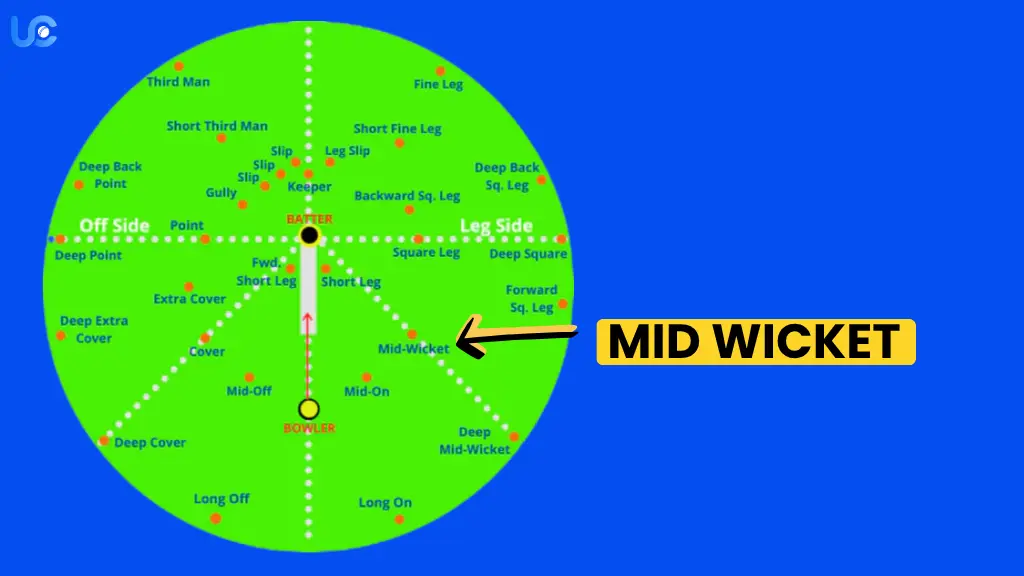
The cricket pitch is mostly circular with two areas called the off and leg sides. At every moment 2 batsmen, 2 umpires, and 11 fielders of a team are active. The choice of the right placement of the fielders can sometimes even decide the winner of the match.
There are terms for different fielding positions in cricket. The area of the ground in cricket which is at the leg side of the pitch, about 45 degrees in front of the square, is called mid-wicket.
The fielder is placed 25 to 30 yards from the batsman’s crease; his main duty is to stop the ball from touching the boundary. Mid-wicket fielders are also in a good position to take catches from batsmen who hit the ball on the leg side.
Basic Positioning and Role
Mid-wicket fielder is the one standing between mid-on and square leg with the sole purpose of covering the area during the family practice sessions. The exact position will differ primarily based on the batman’s nature of playing, the condition of the pitch, and the situation of the match. An experienced mid-wicket fielder should be very mobile, quick on his feet, and good at predicting.
Read Also :- Most Matches Played In IPL Without Injury Substitution
The main job of a mid-wicket fielder is to block the runs only on the leg side. This means to prevent the batters from just rotating their singles and in some cases to lure them into run-out.
Mid-wicket is a position from where one can catch the batsmen off balancing when they play across the line and try for shots on the leg side.
Mid-Wicket Area Usage
Mid-wicket fielders are mostly employed when bowlers are bowling over the wicket. The main reason for this is that the over the wicket bowlers tend to bowl more to the leg side.
When the batsman is known to play a lot of strokes on the leg side or when it is anticipated that the ball will swing or seam towards the leg side, a mid-wicket fielder is stationed there.
Types of Mid-Wicket Fields
Two primary forms mid-wicket fields exist, namely deep mid-wicket and short mid-wicket.
The deep mid-wicket players are located at the boundary line, and their main duty is to prevent the ball from going over the boundary.
Short mid-wicket players are near the batsman’s crease and their main job is to catch the batsmen who are trying to hit the ball at the leg side.
Skills a Mid-Wicket Fielder Needs
Good fielding skills are required by mid-wicket fielders.
For catching: The mid-wicket fielders must be able to make good catches even when the ball is hit very hard and high.
For ground fielding: The mid-wicket fielders must be able to field the ball very quickly and accurately even if it bounces off the ground.
Midwicket players also have to be very fast and athletic so that they can move around the field quickly.
Final Thoughts
The presence of a good mid-wicket fielder can significantly alter the flow of a game by both restricting the runs scored by the opposition and taking big wickets. With time, extraordinary fielding — especially at the mid-wicket area — becomes more and more essential and thus one of the most determining factors in crowning a victor among the two teams.