
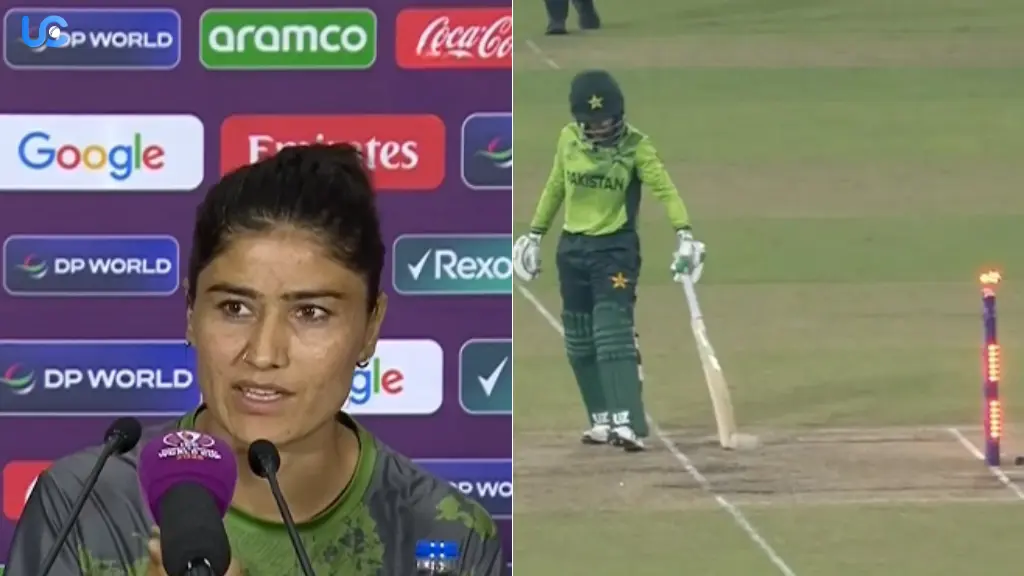
The mysterious and highly controversial run-out of Pakistan opening batter, Muneeba Ali, against arch-rival India at Colombo has, according to Pakistan right-arm quick Diana Baig, been sorted.
Controversies erupted in the India-Pakistan game of the Women’s World Cup on Sunday. What started with Muneeba’s dismissal was so very rare. Pakistan was chasing a target of 248, and it was on the last ball of the fourth over that the Indian players appealed for LBW off Kranti Gaud for Muneeba’s dismissal, which an on-field umpire turned down.
Muneeba had latched the bat behind the crease before Deepti Sharma threw the ball from the slip cordon that hit the stumps. Just at the moment of the dislodging of stumps, Muneeba had suddenly lifted her willow off the ground, with no part of her body behind the crease.
Read Also:- South Africa Women’s Lowest ODI Totals: The Toughest Matches
The confusion spread to the field as well as the stands after contradictory third-umpire decisions flashed on the big screen. At first, the TV umpire had ruled Muneeba not out, and the Indian players had started to walk back to their positions. Soon after, the “not out” decision was overruled and given as “out,” leaving Muneeba bewildered while the Indian players were charged with jubilant celebrations.
After an 88-run comprehensive defeat against Pakistan, Diana had told reporters, “The run-out issue with Muneeba got settled, I think. I don’t want to talk much about it. Whatever happened, whatever was the situation, I think it has now been resolved.”
Dismissed on 2(12), Muneeba had animatedly rejected the on-field umpires’ decision. Heading towards the dressing rooms, her steps were momentarily stalled with instructions from the dugout. Muneeba remained on the field while Pakistan captain Fatima Sana had a discussion with the fourth umpire Kim Cotton.
Seemingly, the Pakistan captain then signaled at Muneeba to clear off, and thus ended the few minutes’ stalemate.
By way of explanation, the ICC Playing Condition 30.1.2 states that “However, a batter shall not be considered to be out of his ground if, in running or diving towards his ground and beyond, and having grounded some part of his person or bat beyond the popping crease, there is subsequent loss of contact between the ground and any part of his person or bat, or between the bat and person.”