
Traditionally, umpires had to solely count on their own judgment to make calls and players were left with no choice but to accept that. Nevertheless, over the years, different technologies have surfaced to support the umpires and the players.
Umpires have often turned to the Hot Spot technology to get a right call in a difficult situation. Now, the question is, what is this technology and how does it come into play?
The present article aims at equipping the reader with a better understanding of Hot Spot technology and its usage in cricket.
Hot Spot Technology
The brain behind Hot Spot technology is Nicholas Bion, a French-born scientist. Although the technology was originally developed for military applications, it soon found acceptance in cricket as well.
Read Also:- Hot-Spot Technology in Cricket
Undoubtedly, you have heard about the Decision Review System (DRS) which is widely used in cricket. The Hot Spot technology is a component of the DRS that is used by the umpires as well as the players.
The technology indicates to the umpires that the ball has come into contact with a bat, a player’s pad, another player’s equipment, or even a player’s body.
How Does Hot Spot Technology Work?
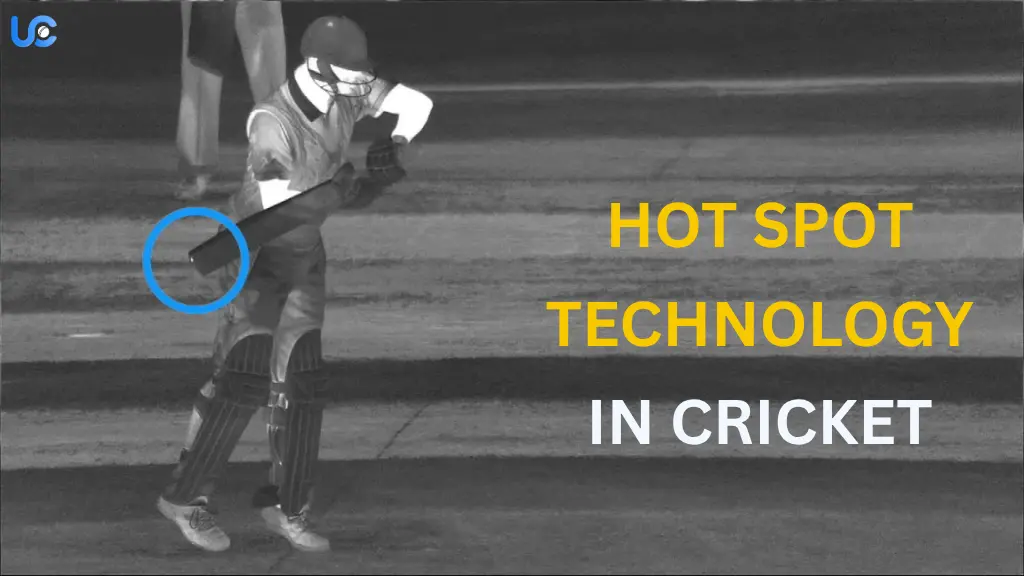
Hot Spot technology employs two infrared cameras positioned at the bowling ends on both sides. The two cameras are capable of detecting the heat generated from the impact of the ball with either the bat, the pad, or the body.
Once captured, the images from infrared cameras are subsequently sent to a computer. The system then streamlines the exact spot of impact, thereby aiding the umpires to figure out if the ball has touched anything else. A bright spot appears at the site of impact if the ball hits the bat or the pad.
When is Hot Spot Technology Used?
It is actually a very simple and straightforward instance where the use of Hot Spot technology comes into picture. It is a part of DRS (Decision Review System) so the third umpire can use the Hot Spot technology if on-field umpires or players request it.
For example, the on-field umpire requests a check to see whether the ball has edged the bat or not. After that, the third umpire will check the Hot Spot visuals to see if the ball made contact with the bat. If the system shows a spot on the bat, then the decision will be out, otherwise, the batsman will not be given out.
Likewise, the third umpire will ascertain the direction of contact and whether it was the bat or the pad when reviewing an LBW appeal. If the ball directly hit the pad, then the umpire can go on with the LBW review.
How is Hot Spot Different from Other Similar Technologies?
Hot Spot is not playing the solo role in spotting ball contact with other objects. Besides it, Snickometer and Ultra Edge are also popular among international matches, but both differ from Hot Spot technology.
While Snickometer and Ultra Edge use sound and Hot Spot utilizes visual, the major difference is in their basis. Snicko and Ultra Edge perceive the contact by the sound which is made when the ball hits the bat or pad.
They operate differently but their ultimate aim is the same — supporting the umpires to make the right call.