
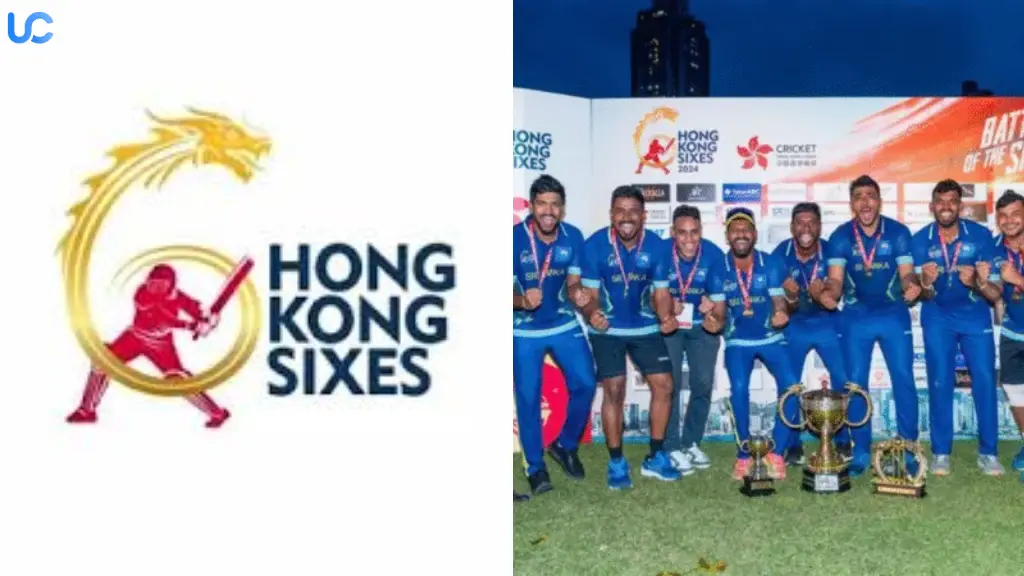
Cricket’s second half of the 20th century was a time of revolutions, and the 21st century is no different with new formats being introduced at regular intervals.
Some of the notable changes that took place include the advent of one-day internationals and the twenty-over formats, together with modifications resulting in the creation of t10 and 100-ball cricket.
But still, the shortest format amongst all is Hong Kong Sixes Cricket. So, in this article, let us first learn about the Hong Kong Sixes cricket tournament and its rules.
Hong Kong Sixes Cricket Tournament
Cricket Hong Kong, the governing body of the region, launched the Sixes cricket tournament in 1993. It’s a very short and very fast format even shorter than the T10 format!
Read Also:- Wide Ball in Cricket: Complete Rules and Umpire Signals Explained
The tournament is not just limited to the Hong Kong team but also features international teams. The big names from the cricket-playing nations, like India, England, and Australia, have sent their teams to participate in the Hong Kong Sixes.
England was the first champion in 1993 and they are, together with South Africa, the most successful team in the competition. Both teams have won the title five times.
Pakistan has claimed the Hong Kong Sixes trophy four times while Australia, India, Sri Lanka, and the West Indies have each had one victory.
In the past, there have been several famous athletes who participated in the tournament, including, but not limited to, Sachin Tendulkar, MS Dhoni, Anil Kumble, Shane Warne, Wasim Akram, Shoaib Malik, Glenn Maxwell, Josh Hazlewood, and Sanath Jayasuriya.
Let’s see what the Hong Kong Sixes cricket tournament can offer us in the form of interesting rules.
Hong Kong Sixes Rules
The rules of this tournament are very intriguing and are in complete contrast to the classic formats.
The Hong Kong Sixes matches are played between two teams of 6 players each, which is a defining characteristic of the tournament. That is exactly where the name of the tournament comes from — the Sixes.
Every team has the right to bat and bowl for 6 overs during a match. Thus, the game unfolds for 12 overs of 6 balls each with a maximum of 60 minutes; however, in the championship match of the tournament, an over lasts for 8 balls.
But this is where things get the most interesting.
For every match played, a team can have 6 players on the field including the selected wicketkeeper. All players besides the wicketkeeper must bowl at least one over, whereas one of them gets to bowl 2 overs.
But when it comes to hitting, all 6 players are allowed to be in and bat. The batting inning will end either when 5 overs have been bowled or all 6 batters have been dismissed.
So, is it the case that the inning does not come to a close with the 5th wicket falling?
Not at all. The last not out batter can continue to bat even if the 5th wicket falls before the completion of 5 overs.
This indicates the tournament is following the last man standing rule. Here, the last batter who has not been dismissed can continue to bat until he is out, while a dismissed batter is allowed to act as a runner at the other end.
The last man has to face every ball. Even if the runner is run out or out obstructing the field, the last man will be given out.
All the rules for dismissals are the same in the games. However, every wide and no ball will add 1 run to the batting team’s score in addition to giving an extra delivery.
Moreover, to increase the excitement, when a batter hits his personal 50 runs, he is required to retire not out. But there is a twist here.
The retired batter can return to the batting order provided that all other batters have been dismissed or have retired. Isn’t it fascinating? This is akin to a power hitting show in just 6 overs.